I couldn't afford the moonphase watch I wanted. So I built it.
One moonphase, finished five ways. Designed in the Netherlands, priced honestly, and run by one person who refused to cut the corners that matter.

The moonphase: the most beautiful useless thing on your wrist
Let me be honest with you: a moonphase won’t help you catch a train or time an espresso. All it does is track the one clock humans have watched for thousands of years — the moon, quietly sliding through its phases in a little window above six o’clock. That is exactly why I’m obsessed with it. In a world built to grab your attention every second, I wanted to make something that does the opposite — something that just reminds you to look up.
The moonphase complication the big houses keep for themselves
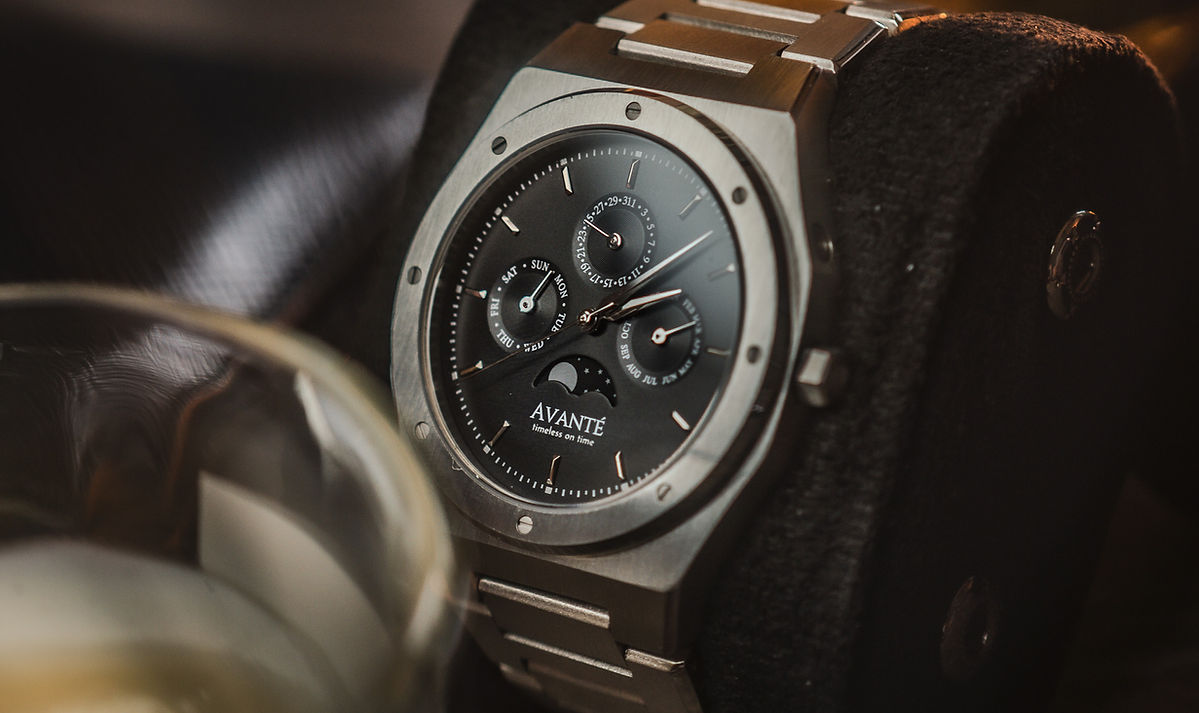
A real moonphase usually lives on watches that cost more than a car. I was never going to afford one of those — so I became obsessed with doing it honestly, at a price that doesn’t ask you to choose between the watch and the rest of your life. A genuine Japanese MIYOTA 6P00 quartz moonphase. Sapphire crystal on every finish. 316L marine-grade steel. A 40 mm case that quietly disappears on the wrist. €180 — the same price on a slow Tuesday as on Black Friday.
I won’t pretend it’s Swiss, and I won’t dress €180 up as ‘luxury’ to make you feel something. It’s designed in the Netherlands, and I’ll tell you exactly what’s in it and what it’s made of. The watch can do the talking.
Sapphire crystal, not cheap glass — what really ages a watch
Here’s something the marketing won’t tell you. Plenty of ‘designer’ watches — some at two or three times my price — still ship with cheap mineral or hardened-acrylic crystal. It looks perfect in the box. Then comes a doorframe, a desk edge, a set of car keys — and within a season the face is a web of fine scratches you can never polish out. The watch looks old before you’ve even worn it in.
That’s the one corner I refused to cut, because it’s the part you actually touch the world with. Every Avanté gets a sapphire crystal — one of the hardest materials there is, just under diamond. Drag it down a concrete wall and it shrugs. The case is 316L marine-grade steel, the same alloy used for ship fittings and surgical tools — not the soft plating that dulls and discolours. Buy it once, wear it for years. That was the whole point.
Why it’s a quartz moonphase, not an automatic
It’s the question I get most, so let me answer it straight. At €180, the only automatic movements I could honestly fit would be entry-level ones — and they’d make this a worse watch, not a better one. Most can’t drive a true moonphase at all. The few that can are thicker and heavier on the wrist, and they drift further off time in a single week than my quartz does in months. Going automatic at this price would buy me a nicer word for the marketing and hand you a clumsier watch. I wasn’t willing to make that trade.
Quartz is the honest choice here: it keeps the case slim, the moonphase genuinely accurate, and the price fair. You set it once and it quietly follows the real moon.
Do I want to build an automatic Avanté one day? More than you know. But only when I find a movement that truly meets my standard and carries a real moonphase — and only if I can still put it on your wrist for a fair price. The day both of those are true, the people on this list will be the first to know. Until then, I’d rather do one thing properly than two things halfway.
Why a Dutchman makes
moonphase watches.
People ask me this a lot. The honest answer: the Netherlands never had a watch industry — what it had was an obsession with reading the sky. We were a nation of navigators and astronomers who needed the heavens to find our way home across the water. Looking up wasn’t romance here. It was how you survived.
In 1657 the Dutchman Christiaan Huygens invented the pendulum clock and, for the first time in history, tamed time to within seconds a day — nothing on earth kept better time for nearly three centuries. The same man discovered Saturn’s rings and its moon Titan. He simply could not stop looking up.
A century later a wool-comber named Eise Eisinga built the entire solar system into the ceiling of his living room in Franeker — by hand, to calm a country that feared the planets were about to collide. He finished it in 1781. It still turns today — the oldest working planetarium on earth, the little moon still crossing his ceiling exactly on time.
That’s the line I see myself standing in: not Swiss watchmaking, but Dutch sky-watching. A moonphase from the Netherlands isn’t a marketing angle to me. It’s the thing I come from.